
Acquiring a new customer is between 5 and 7 times more expensive than keeping one. A figure that has been around for years. However, the majority of B2B businesses continue to invest heavily in acquisition, at the expense of retention. The result: costs that accumulate, partners that run out of steam... and 67% of loyalty programs that fail before they have produced any measurable effect.
However, 2026 is changing the situation. Radically. AI customizes goals in real time, QR codes connect each field sale to the platform in a few seconds.
Method, tools, technologies, field results: through this comprehensive guide and to get a very clear picture, MASLO offers you a complete overview of the subject of B2B loyalty in 2026.
B2B loyalty in 2026: a discipline that no longer resembles what it used to be
For a long time reduced to a gift catalog and a few end-of-year discounts, B2B loyalty has undergone a silent transformation. This first act sets the foundations: definitions, challenges, and what 2026 is actually changing for sales and marketing departments.
What is B2B loyalty? Definition and key concepts
B2B customer loyalty is the strategic approach by which a company consolidates the relationship with its commercial partners (resellers, distributors, prescribers, installers) in order to maintain and develop their commitment over the long term.
It is characterized by recurrent animation mechanisms, measurable objectives and a recognition system calibrated to the profiles and behaviors of participants. B2B loyalty differs from simple customer satisfaction in that it is proactive : it does not react to disengagement, it anticipates it.
At the outset, let us distinguish between two concepts that are often confused:
- Loyalty is a state : a partner is loyal because they continue to buy, recommend, and get involved.
- Loyalty is an approach : it is the set of deliberate actions that produce this state. One is a result, the other is a policy.
In a B2B context, each lost partner represents a considerable loss of profit. Sales cycles are long, decisions involve multiple stakeholders, and the amounts involved justify a serious investment in retention. This is why companies that master B2B loyalty do not treat it as one marketing program among others: they make it a structuring growth driver [Learn more about modern loyalty tools].
B2B vs B2C: why the same rules don't apply
A common mistake is to transpose B2C mechanics into a B2B context. Loyalty cards, points earned on repeated purchases, immediate discounts: these tools work well when the decision is individual, quick and emotional. In B2B, the reality is radically different.
In B2B, the reseller is not an end consumer. It is a business partner whose loyalty is built over time, by the repeated proof that the brand that animates it understands its constraints, respects its level and offers it tangible value. And it is this keen understanding that distinguishes programs that last from those that run out of steam after a few weeks.
What's changing in 2026 for B2B loyalty programs
B2B loyalty in 2026 is not (anymore) that of 2020. Four structural trends are reconfiguring the expectations of decision-makers and redefining program performance standards.
- Artificial intelligence as a personalization accelerator. B2B programs go beyond the uniform logic. AI makes it possible to calibrate goals, anticipate disengagement and recommend the most appropriate rewards for each profile, in real time. 71% of companies plan to integrate AI into their business processes (Maslo internal source). A number that reflects a fundamental movement, and not a trend.
- Generalized omnicanality. From the QR code on packaging to the management dashboard, through push notifications and SMS reminders, the contact points between the brand and its partners are multiplying. An effective program in 2026 builds on this diversity of channels to maintain engagement between highlights.
- The rise of the soft stomach. The real battle for loyalty is not about top performers, who are already established. It depends on the 50% of intermediary partners whose potential is untapped. It is in this segment that the growth gains are the most significant. This is therefore where the animation effort must be concentrated.
- Conformity as a differentiator. RGPD, ISO 27001 certification, traceability of reward flows: major accounts now include these criteria in their tenders. A loyalty program that cannot justify its compliance is a program that does not pass the legal filters of decision-makers.
Building your B2B loyalty program: the DOMM method in practice
Having a good intention of retaining loyalty is not enough (67% of the programs put in place fail). What Maslo has developed over its 10 years of field experience with industrial, automotive and aviation networks is a method in four sequential phases: Diagnosis, Objectives, Motivation, Measurement. The DOMM diagram is not a communication tool: it is an operational protocol.
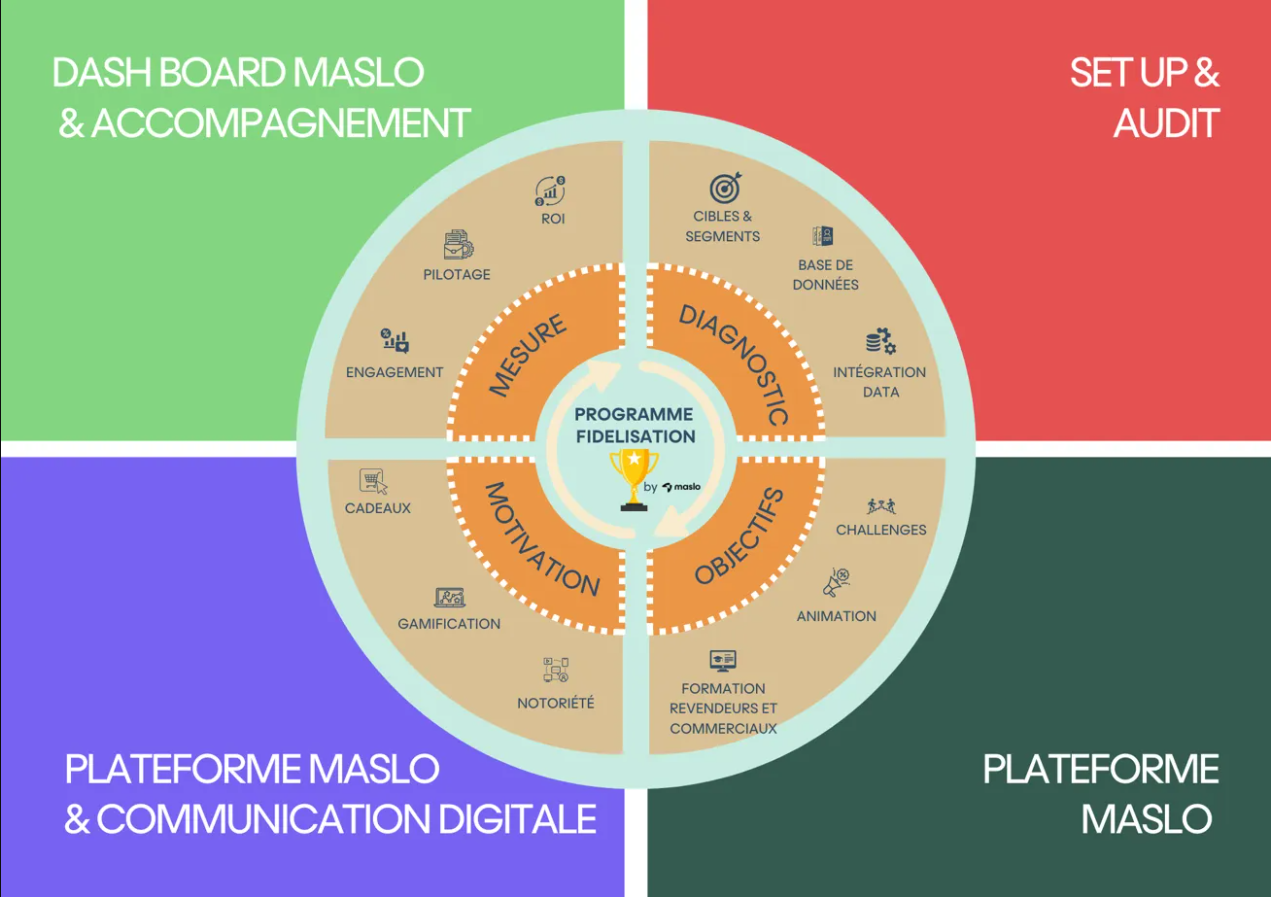
Diagnosis: identifying the right targets and segmenting your network
A loyalty program rarely starts with a blank slate. It starts from an existing network, with its strengths, imbalances and areas of untapped potential. The objective of the diagnostic phase is to map this network accurately before designing any reward mechanism.
The “soft belly”: the most ignored growth potential
In any distribution network, natural distribution follows a three-third logic:
- thereabouts 25% of top performers that consistently exceed their goals,
- 25% underachievers in trouble,
- and 50% of intermediary partners. It is this last segment, often referred to as the “soft belly”, that represents the greatest potential for growth. The top performers are already engaged. Underachievers require specific support. Intermediaries, on the other hand, are waiting for a clear signal and an accessible mechanism to make progress [Learn more: Underperforming retailers: from loyalty to relaunch]
The 4 B2B2C levels: from the direct relationship to the integrated ecosystem
The complexity of a distribution network directly determines the architecture of the loyalty program. Maslo distinguishes four levels of maturity, from the simplest to the most sophisticated:
- “Starter” bearing : the direct relationship between manufacturer and end customers. Simple to manage, this model allows immediate loyalty of the end consumer, without intermediaries to manage.
- “Intermediate” level : the manufacturer chain to retailers to end customers. Complexity is increasing: it is necessary to simultaneously animate distributors and maintain the momentum with the end customer.
- “Advanced” level : the intensive animation of the distribution network. The effort focuses on motivating the retailers themselves, who have become active brand ambassadors in their professional environment.
- “Ultimate” bearing : the complete ecosystem integrating central purchasing agencies. Loyalty is becoming a multi-actor collaborative project, requiring perfect coordination and a robust technical platform.
The diagnostic phase makes it possible to identify where the network is located and what is the desired trajectory. It is from this reading that the objectives are calibrated. [Learn more]
Objectives: program formats, challenges and activation mechanisms
Once the diagnosis has been made and the priority segments identified, the “Objectives” phase consists in choosing the animation mechanisms best suited to the context. Maslo offers four proven formats, designed to adapt to all levels of digital maturity of networks.
The 4 program formats: from the simplest to the most integrated
- The turnover commission. The most direct and transparent approach: a percentage indexed to sales, progressive according to the levels reached. Ideal for starting a program on a network that is not used to incentive mechanisms. Example: an office supplies wholesaler offers 2% commission up to 10,000 euros in sales, 3% beyond that. Every retailer knows exactly what to expect, without technical complexity.
- The rewards catalog. The points accumulated during sales are convertible into rewards from the Maslo catalog (more than 150,000 references: items, e-cards, trips, premium gifts). This format creates a powerful suction effect: each participant aims for a specific reward that corresponds to their preferences. Logistics management is fully taken care of by Maslo, including delivery throughout Europe.
- The traced product. Each unit sold is identified by a unique code. The reseller enters this code on the platform at the time of sale: the points are credited instantly and the transaction is validated in real time. This format offers maximum traceability, particularly suited to technical equipment and products with high unit value.
- The integrated QR code. A QR code attached to the packaging, label or POS support is scanned by the reseller or installer at the time of sale. Points are awarded immediately, with no validation time. A format that allows the integration of complementary functionalities: gamified micro-learning on products, access to the ranking in real time, consultation of the balance of points. It is the most immersive and engaging format for field networks.
QR codes and landing pages: recruit, activate, engage
The QR code is the perfect bridge between the physical world and the digital program. Its use in a B2B loyalty program covers three distinct and complementary functions:
- Recruiting: a QR code on a POS medium, a brochure or a mailing redirects the reseller to the landing page dedicated to the program. In two minutes, he registers, creates his profile and activates his access to the platform. It is the simplest and least expensive entry into the program for a geographically dispersed network. Wilo used this mechanism to recruit its installers via a landing page hosted directly on its site, generating a 223% increase in subscribers in two years
- The sales statement : the retailer scans the QR code of a product sold, which triggers the automatic allocation of points on their account. No manual entry, no validation by a third party. Midea has deployed this mechanism on its France and Spain networks with POS supports including specific QR codes for each product range.
- Access to the program : a QR code also allows you to directly access the ranking, your point balance or an ongoing challenge, without going through a manual connection. This direct link between the physical act and the digital interface maintains the commitment between two highlights of the program.
Motivation: gamification, rewards and multi-channel communication
Setting the right goals and choosing the right format is not enough. What distinguishes a program that lasts from a program that runs out of steam after a few weeks is the ability to maintain the commitment over time. This is the role of the “Motivation” phase (animate, stimulate, recognize)
Gamification mechanics: why do they work
Gamification can be understood as the transposition of game mechanisms into a non-fun context. Applied to B2B loyalty, it transforms the relationship between a brand and its retailers into a progressive, stimulating and recognized experience. Engagement increases by 48% on average in programs that incorporate gamification mechanisms [Learn more].
Five mechanics form the core of a Maslo program
- Points and accumulation : each sale, each validated action, each completed challenge generates points credited in real time. The progress is visible and permanent.
- Rankings and competitions : the scoreboards, which can be viewed on the application, create a positive emulation between participants. Healthy competition is a powerful driver of engagement, especially in commercial environments.
- Badges and recognition : milestones of progress materialize the steps taken. Each badge obtained confirms to the participant that their effort is seen and valued.
- Challenges and challenges: short goals (one to four weeks) combined with attractive rewards maintain a positive tension between program highlights.
- Gamified micro-learning : short quizzes on products or sales techniques, integrated into the program and rewarded in points, combine training and commitment in a format accessible from the field.
These mechanics produce measurable results. Out of a panel of 930 salespeople led via the Maslo platform, engagement increased by 65% and sales by 29% across all 30,000 challenges analyzed (internal Maslo data).
The quest and the premium club: building loyalty over time
Beyond specific challenges, the most effective programs incorporate a permanent progression mechanism. The logic is that of role-playing applied to B2B loyalty : each micro-action completed unlocks a level and brings the participant closer to premium status. It is no longer just commercial performance that is rewarded, but the involvement itself.
For example, the onboarding sequence of a Maslo program can be structured as follows:
- Connect to the application : the participant receives their first welcome points and discovers the interface.
- Profile completion (photo, contact details, product specialty): a symbolic but visible reward encourages the finalization of the profile, which improves the quality of program data.
- First sharing on social networks or in your professional network : the participant is rewarded and gets the “Ambassador” badge.
- First purchase declared or first bill scanned : automatic triggering of level 2 and welcome notification in the “Active” category.
- First challenge completed : access to the Premium club with its exclusive advantages (dedicated rewards, priority access to new challenges, visible status in the ranking).
Psychological interest of this mechanism : the more a participant progresses through the levels, the more the effort made creates a feeling of investment. Leaving the program becomes costly, not only commercially, but psychologically. This is exactly the logic that explains the sustainability of major loyalty programs in the video game and travel worlds, applied here to an industrial B2B context.
The sequence of levels and the access thresholds to the Premium Club are of course fully configurable according to the customer context: sector, network size, nature of products, program objectives. Because there is no one-size-fits-all model, the architecture is flexible.
SMS and push notifications: the most underused reactivation channel in B2B
A given fact: The SMS has an opening rate greater than 90%. In a B2B context (where field resellers are rarely in front of their computers), this is the most direct and effective channel for maintaining engagement between two program highlights. However, it remains largely underused in traditional B2B loyalty schemes.
Thus, four use cases structure the use of SMS in a Maslo program:
Launch of a new challenge : personalized notification with the objective and the associated reward. The tone is concise, the invitation is direct.
- Rating alert : the participant is informed of his position and the gap that separates him from the podium. This type of message generates feedback on the application in the following minutes.
- End of period goal reminder : 72 hours before the end of a challenge, an encrypted message reminds you of what still needs to be done to reach the next level.
- Reward confirmation : when a reward is unlocked, the instant notification materializes the recognition. It is the moment of satisfaction that anchors the desire to participate again.
The Maslo mobile application (available on iOS and Android) combines SMS and push notifications to ensure complete coverage, including on field networks that are not equipped with digital tools.
Artificial intelligence and digital technology at the service of B2B loyalty
As in a number of other fields, artificial intelligence does not replace the human relationship in B2B loyalty. It increases it and structures it. From behavioral scoring to the personalization of rewards (including the early detection of disengagement), it has become a discreet but decisive accelerator of program performance. This third act presents operational use cases and the end-to-end digital journey that they make possible.
What does AI actually change in a loyalty program
The concrete applications of AI in a B2B loyalty program are no longer prospective. They are operational in new generation platforms and produce measurable results across all phases of the program.
Focus on automatic invoice recognition (6th benefit)
The user experience: a field dealer has just sold three units from a range eligible for the program. Instead of manually entering references on a platform or waiting for validation by an administrator, he photographs his invoice from the Maslo application. In a few seconds, the AI analyzes the document, recognizes the product references, calculates the corresponding points and credits them to its account. The process is complete before the dealer has even put their phone away.
The double operational benefit: This mechanism creates a virtuous circle:
- On the participant side: The instantaneity of the reward reinforces the psychological link between the act of sale and the reward, where traditional validation deadlines erode commitment.
- On the manager side: The disappearance of manual control tasks frees up valuable administrative time, which can be used for the strategic management of the network.
Data based proof
This efficiency is based on industrial reliability: during a recent challenge, Maslo's AI was 99% accurate in processing the last 1,000 invoices.
The performance is all the more notable as the system had to juggle with 400 different billing formats (various distributors), stabilizing this reliability rate in less than 15 days. For the manager, it's a “monster” time saver and the guaranteed to validate the premiums in record time.
Strategic impact
Beyond operational comfort, this agility translates into a measurable improvement in commitment. Loyalty programs that rely on algorithmic personalization and predictive analytics are seeing a churn reduction of up to 30% and a significant increase in “Customer Lifetime Value”, thanks to proactive interventions on partners at risk (Netguru, 2026).
Personalization and predictive marketing: three field scenarios
These six benefits of AI make sense in concrete situations. Here are three scenarios that illustrate how artificial intelligence fits naturally into the daily life of a Maslo loyalty program.
Scenario 1 → Detecting disengagement and proactive reactivation
- background : an installer who usually placed five to eight orders per month on Wilo products saw his activity drop to a single order over six weeks.
- Impact of AI : the anomaly is detected automatically. A personalized SMS is sent with a special challenge based on its history: “Three installations this week, and you double your points balance”.
- Result : reactivation before final break, without manual intervention by the program manager.
Scenario 2 → Customizing goals at scale
- background : a network of 200 resellers receives an identical program with a uniform objective of 10 sales per month.
- Impact of AI: automatic segmentation into four profiles based on performance history. Each profile receives a calibrated challenge: 7 sales for profiles in progress, 12 for established profiles, 5 for profiles in difficulty.
- Result : the participation rate increases significantly, because each participant sees the objective as achievable. Because a program that is too ambitious for some and too simple for others is a program that no one wants to participate in.
Scenario 3 → Optimizing communication through learning
- background : the program sends the same push notifications on Monday morning to all participants.
- Impact of AI : after four weeks, the AI detects that field retailers respond better to messages on Thursday in the late afternoon. Shipments are automatically recalibrated by profile.
- Result : the opening rate of program communications is increasing. Each improvement in rates feeds into the model, which is continuously refining its recommendations.
The complete digital journey: from the QR code in the field to the real-time dashboard
AI, QR codes, SMS and the management dashboard are not isolated tools. They form a coherent system, designed to support the reseller every step of the way through the program, from enrollment to reward.
To note: Maslo programs can be deployed as a full white label : colors, logos, program name, challenge structure. Key account customers who want to maintain their brand identity in the face of their networks can deploy a fully personalized program without exposing the provider. MyLink (Newrest Wagons-Lits), the platform Midea France And Spain, space Vueling : these programs exist under identities specific to each client.
In terms of data security, Maslo is ISO 27001 certified. Participants' data is hosted in France, and the collection processes are fully compliant with the RGPD (explicit consent, no automatic reminder, integrated right of deletion). For major accounts that include these criteria in their tenders, these guarantees are non-negotiable elements [Learn more: certifications and security guarantees].
Measure, manage and prove the ROI of a B2B loyalty program
A loyalty program without measurement tools can be assimilated to a simple “expense”. With, it's an investment. This fourth act gives the decision-maker the tools to manage his program in real time, calculate his return on investment and defend his budget internally with solid data.
The essential KPIs of a B2B loyalty program
The indicators of a B2B loyalty program are structured into three complementary categories. Measuring them simultaneously provides a complete picture: what the partners are doing, what they are feeling, and what the program is producing in terms of revenue.
A well-designed program improves the retention rate by 15 to 30% depending on the sector. Combined with the mechanical effect of Bain & Company (+5% retention = +25 to 95% profitability), calculating the ROI over 12 months is rarely disappointing for programs that last over time.
How to calculate the ROI of your B2B loyalty program
Calculating the ROI of a B2B loyalty program is based on four variables that must be filled in rigorously and honestly before launching the program. It is reliable, even if this calculation cannot be the subject of exact science.
Basic formula and key variables
Formula: ROI = (Gain generated by the program minus Total cost of the program)/Total cost of the program x 100
Gain variables to be quantified :
- Increase in turnover per active participant versus non-animated control group
- Reduction in the reseller churn rate (value of a retained partner)
- Increase in the share of wallet (Share of Wallet)
Cost variables to be integrated:
- Platform license
- Cost of rewards distributed
- Internal management time (significantly reduced by AI and automation)
- Programmatic communication budget
Measurement horizon : 3 months for the first signs of commitment/12 months for a reliable and defensible ROI measure in the management committee.
Realistic budget : 50 to 1,500 euros per month depending on the size of the network and the level of rewards.
The Maslo dashboard centralizes all the data necessary for this calculation in real time. URSSAF exports also make it possible to manage the declaration of awards in strict compliance with the applicable fiscal framework. [Request a demo].
What this means in practice: Maslo loyalty programs in action
The methods are worth what the results confirm. Here are four programs deployed by Maslo in industrial, automotive and aviation contexts, with figures measured in the field.
CUSTOMER CASE 1: Renault Sodicam (since 2022)
A wholly-owned subsidiary of the Renault Group — marketing of IXELL parts, accessories and paint
Problem : How to manage and challenge an extended commercial network while reporting field data on sales by product range?
Answer: Maslo : Several dedicated platforms with declarative challenges for the Renault partner network, coupled with an automatic feedback of field sales by range.
Results:
- More than 15,000 statements on the latest Western Territory challenge, from more than 800 participants
- +23% increase in strategic indicators for animated ranges
- +90% engagement rate of participants on the platform
- More than 2,000 challenges launched between 2022 and 2025 on Sodicam/Renault Group platforms
CUSTOMER CASE 2: Wilo (since 2022)
World leader in pumps and pump systems — present in more than 50 countries
Problem: How to retain installers by setting up an innovative system of retro-commissions issued in gift points on purchases of Wilo products?
Maslo answer: Dedicated landing page on the Wilo site + Maslo platform + simple challenge with automatic calculation of earnings as soon as the purchase amount is entered by the installer.
Results:
- +223% of registrants in two years since the platform opened
CUSTOMER CASE 3: Newrest/Vueling (since 2020)
The world's leading airline catering player — 2,800 flight crews in 27 countries of the European Union
Problem: Lack of communication tools for a mobile and multilingual population (5 languages). Need a mobile application to organize regular events, supported by rewards logistics covering all of Europe.
Maslo answer: Multilingual private exchange space (French, English, English, Spanish, Spanish, Portuguese, Italian) accessible on mobile + on-board sales challenges + delivery of rewards in 27 EU countries.
Results:
- +50% of users connected regularly to monitor their challenges
- More than 20,000 euros in winnings distributed in 2024
- Over 20 gift orders per month on average
CUSTOMER CASE 4: Midea (2024-2025)
World leader in household appliances and air treatment systems — present in more than 200 countries
Problem: How to retain installers of Midea products in France and Spain in order to significantly increase market share in these two territories?
Maslo answer: White label application + loyalty programs deployed in France and Spain + POS communication supports with QR codes for field activation.
Results:
- Program launched in the first quarter of 2025. Initial results in the process of consolidation.